

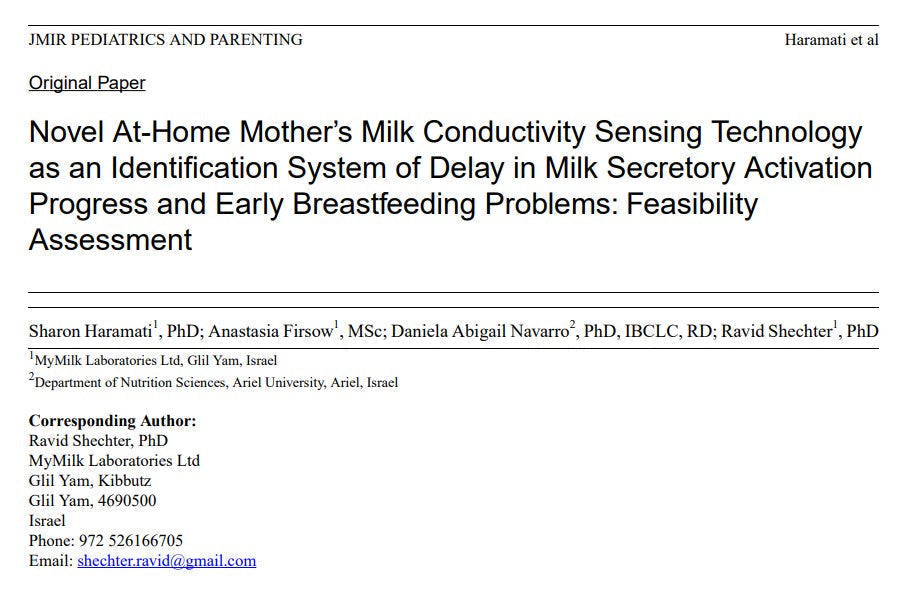
The Breastfeeding Medicine Podcast, produced by clinicians and lactation experts Anne Eglash MD, IBCLC, FABM and Karen Bodnar, MD, IBCLC, FABM designed to bridge clinical research with real-world lactation care. In their #106 episode, the hosts examined our JMIR Paediatrics and Parenting published research on milk conductivity tool for measurement of secretory activation, bringing their clinical depth and perspective to the discussion. Their framing offers a valuable lens into why objective, physiological measures of secretory activation progression matter in real-world care.
Framing the Study Within Clinical Experience
The Day-by-Day Physiology of Early Lactation
Dr. Anne Eglash began by explaining the traditional challenge: many studies have relied on asking lactating parents when their breasts feel full or heavy as a marker of when milk “comes in.” In the podcast, she emphasized that this subjective perception is often inaccurate. Some people never feel heaviness despite already producing mature milk, while others cannot distinguish sensations reliably. She contrasted this with what she called “a more scientific way of measuring secretory activation,” which is to analyze breastmilk sodium (milk electrolyte). She described the biological basis for this: early colostrum is high in sodium because the tight junctions between alveolar cells are still disorganized. As progesterone levels fall and tight junctions close, lactose production increases, milk volume rises, and sodium levels drop, signaling the onset of mature milk production. She noted that a sodium level at or below approximately 16 mmol/L is widely accepted as a marker of this maturation.
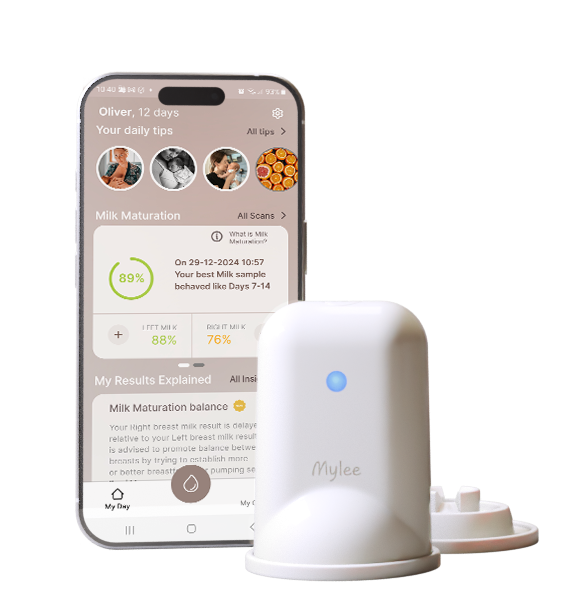
In this context, she introduced the work of our team, explaining that the researchers developed a smartphone-enabled sensor allowing parents to measure electrolyte levels in their own milk. She pointed out why such a tool could be meaningful: many parents begin supplementing by the first month because they perceive they do not have enough milk. Early supplementation, however, may actually delay secretory activation by reducing the frequency of nursing. Because lactation relies heavily on maintaining high prolactin levels through frequent milk removal, she emphasized that being able to identify the physiologic state of secretory activation could, in the future, help clarify what is truly happening.
How the Podcast Explained the Maturation Index and Its Patterns
She described how the study gathered data from 592 mothers and about 1500 samples, collected by lactation consultants and by pregnant participants who used the tool postpartum. The samples were categorized according to breastfeeding status: an exclusively breastfeeding “normal” group, a low-supply group identified by consultants, and a breastfeeding-problems group without specific diagnoses.
A key point of the podcast was how the researchers transformed electrolyte values into a continuous maturation index. Rather than reporting raw sodium, the study created a nomogram that expressed each raw measurement as a percentage of maturation, where “1” indicated fully mature milk and values such as 0.2, 0.4, or 0.6 represented being 20%, 40%, or 60% of the way toward full secretory activation. Dr. Eglash described this framework clearly and repeatedly: a continuum rather than a binary milestone.
This framing became central to their discussion of the results. The podcast highlighted that parents who were exclusively breastfeeding reached about 90% maturation by day 6, and then stabilized around full maturation by day 12. In contrast, those with low milk production reached only about 70% by day 10 and did not approach 90% until days 16–20, often without reaching full maturation even by day 20. These day-by-day patterns illustrated, in the hosts’ words, how secretory activation can progress at very different rates depending on circumstances.
A Clinical Conversation on Measuring Secretory Activation in high resolution
The conversation then moved into clinically practical reflections. They emphasized that thinking of secretory activation as a progression across days, rather than a single moment, helps make sense of why some families struggle. They remarked that this measure could someday help distinguish between parents who have not yet completed secretory activation and those whose glandular capacity is inherently limited. They contrasted the electrolyte-based milk maturation index with the common clinical reliance on feelings of breast fullness or pump-report data, explaining that those methods can be misleading and that the physiologic maturity of milk production may be a far better marker of what is truly occurring.
They also highlighted how the day-level resolution opens the possibility of evaluating the effect of interventions. They noted that when a parent experiences delayed milk production, clinicians often cannot tell whether the issue is insufficient glandular tissue, hormonal suppression, insulin resistance, contraceptive interference, or simply incomplete secretory activation. The hosts described how seeing a sustained high conductivity level on day 10 [low MM %], for example, might point toward a blockade such as a contraceptive implant, whereas a low conductivity level [high MM %] combined with low volumes might suggest insufficient glandular tissue instead. They expressed how difficult it can be to make these distinctions in practice and how strongly clinicians desire tools that provide clearer physiologic answers.
They also described clinical scenarios, such as PCOS, insulin resistance, or late-onset supply increases, where tracking a maturation index over time could illuminate patterns that otherwise appear confusing. Their discussion repeatedly returned to the emotional weight clinicians feel when they cannot give parents clear answers, and the potential of physiologic tracking methods to reduce that uncertainty.
Toward the end of the segment, while their focus remained on the scientific value and on how such tools might eventually support clearer clinical understanding, the hosts discuss how new emerging technologies should be introduced thoughtfully and not rushed directly to consumers, in a way that supports, rather than complicates, breastfeeding care.
Their thoughtful discussion, scientific, clinical, and deeply human, highlighted the implications of being able to visualize this physiologic transition with high resolution, individually, on the spot. By exploring the full maturation trajectory and its meaning in clinical practice, the podcast brings forward the depth and significance of the research in a way that resonates across the lactation community, offering clinicians a means to interpret early lactation that aligns with the lived complexity they encounter every day.
Go to The Breastfeeding Medicine Podcast (#106) - Secretory Activation & Microchimerism Among Breastfed Infants. Anne Eglash MD, IBCLC, FABM and Karen Bodnar MD, IBCLC, FABM. December 10, 2023. IABLE. Link




Leave a comment
All comments are moderated before being published.
This site is protected by hCaptcha and the hCaptcha Privacy Policy and Terms of Service apply.