

Risk factors for impaired lactations are increasing in prevalence, nevertheless lactation difficulties are not recognized in time in the clinical environment. The new 2026 published review, “Diagnosing Breastfeeding Difficulties: Where Do We Stand?” (Galante et al., Maternal & Child Nutrition, 2026 ; PMCID: PMC12699322) underscores that the field of lactation diagnostics is scientifically advanced but clinically underserved.
While milk biomarkers of secretory activation are well understood, the tools that make them usable have only recently begun to emerge. In this review, the authors provide comprehensive evaluations of how we detect breastfeeding problems, what biomarkers reveal about secretory activation, which populations are at risk, and why modern tools for monitoring are essential.
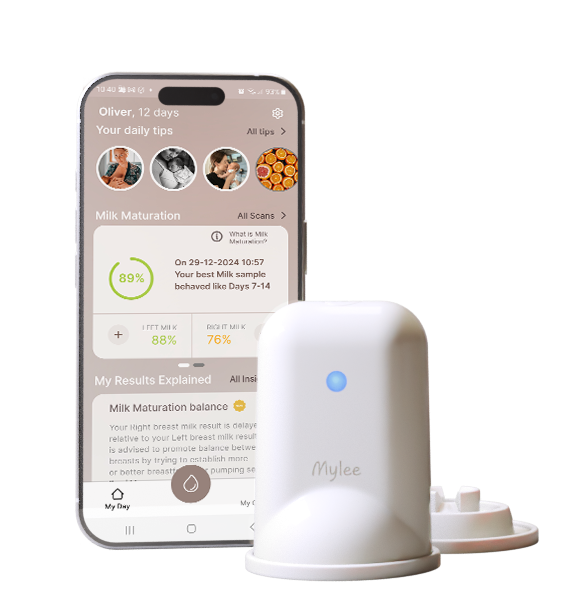
By citing our JMIR publication by Haramati et al. validated home-tracking tool within its assessment of new promising validated/piloted portable devices for evaluation of lactation progress at point of care, the review highlights how technologies like Mylee offer a practical, evidence-based solution that begins addressing the long-standing diagnostic gaps clinicians face today.
For lactation consultants, this publication reinforces the importance of objective, early monitoring, especially for high-risk dyads, and signals a shift toward more personalized, data-supported breastfeeding care.
Below are the key highlights the authors report including what they identify as critical missing elements in lactation diagnostics today.
The Core Challenge: Hidden Lactation Difficulties
Galante and colleagues emphasize that impaired lactation is under-recognized across healthcare systems. Although secretory activation typically occurs within 72 hours after birth, a substantial proportion of mothers experience delays that go unnoticed until milk supply problems are already entrenched.
The review stresses that current clinical pathways do not systematically screen for delayed or impaired secretory activation, leaving both clinicians and families without clear early warning indicators.
The review synthesizes evidence showing that delayed or impaired secretory activation is more common among:
- Mothers with obesity or metabolic disorders
- Those who delivered via caesarean or experienced complications
- Preterm dyads
- Mothers and infants separated early postpartum
- Families with early formula introduction
The authors argue that these groups would benefit most from routine, objective monitoring, yet they are the least likely to receive it under current clinical practices.
What Secretory Activation Biomarkers Tell Us
The authors summarize the body of evidence linking specific milk biochemical markers, including sodium, potassium (and electrolytes balance), to the physiological progression of secretory activation.
While covering the scientific evidences, and summarizing major research in the field, they conclude that:
- These biomarkers reliably indicate the transition to mature milk production.
- Abnormal levels are strongly associated with delayed or impaired lactation.
- Until recently, most methods for measuring these markers considered not suited for routine practice, requiring lab analysis, repeated sampling, or 24-hour milk collection.
This disconnect between scientific insight and clinical usability is one of the central gaps identified in the review.
A major contribution of the review is its clear articulation of what is lacking in current lactation diagnostics. According to the authors, the field urgently needs:
- Clinically feasible, validated tools for measuring biomarkers without laboratory dependence
- Long-term outcome studies evaluating how biomarker-based monitoring affects breastfeeding success
- Standardized protocols for collecting, interpreting, and acting on biomarker data
- Real-time or near-real-time feedback systems suitable for both clinics and home use
- Methods appropriate for high-risk populations, where early identification is most critical
The authors emphasize that these missing elements limit clinicians’ ability to detect delayed secretory activation early enough to intervene effectively.
Point-of-Care and Home-Ready Tools - A Promising Shift
The authors review emerging technologies that help translate biomarker science into practical use. In this context, the review explicitly cites the validated handheld tool developed by Haramati and colleagues - the scientific basis behind Mylee.
The recent findings of validating or piloting portable devices that providing real-time tracking of milk maturation and secretory activation progress, without laboratory infrastructure, align with the authors’ call for feasible, acceptable, and low-burden methods suitable for home and clinical environments.
The review positions such tools as critical steps forward, directly addressing the practical limitations that have historically prevented biomarker-based diagnostics from entering mainstream lactation care.
Clinical Takeaways from the Review
Galante et al. conclude that:
- Monitoring secretory activation using biomarkers has strong clinical potential, particularly for guiding early intervention.
- The main barrier is lack of accessible, validated measurement tools, not lack of scientific understanding.
- Portable technologies, including those already validated (such as the Mylee tool (cited as Haramati et al.), represent a needed clinical bridge between research and practice.
- Future work must focus on integrating these tools into care protocols and linking them to breastfeeding outcomes.
Galante L et al. “Diagnosing Breastfeeding Difficulties: Where Do We Stand?” Maternal & Child Nutrition, Volume22, Issue1, (2026), e70153




Leave a comment
All comments are moderated before being published.
This site is protected by hCaptcha and the hCaptcha Privacy Policy and Terms of Service apply.